By the Strello team
As physicians, we often started visits hearing about a difficult phone call or an upsetting interaction at reception.
We heard similar frustrations in more than 100 interviews with clinics as we built Strello.
Front-desk staff told us about demanding workloads and rude patients; managers described turnover and repeated training. Receptionists juggle calls, patients and messages while explaining delays and policies they often cannot control. They also bear the brunt of patients’ frustration. Reporting on behaviour since COVID-19 describes a rise in everyday rudeness, while a Lancet study estimated that depression and anxiety each rose by roughly a quarter worldwide in 2020.
This made us think: “This is a big problem. Can we measure how big?”
What we found
We collected 406 reviews from 24 clinic listings across five Ontario cities. We also examined all 254 unique one- and two-star reviews in our collected material, including those already in the main sample.
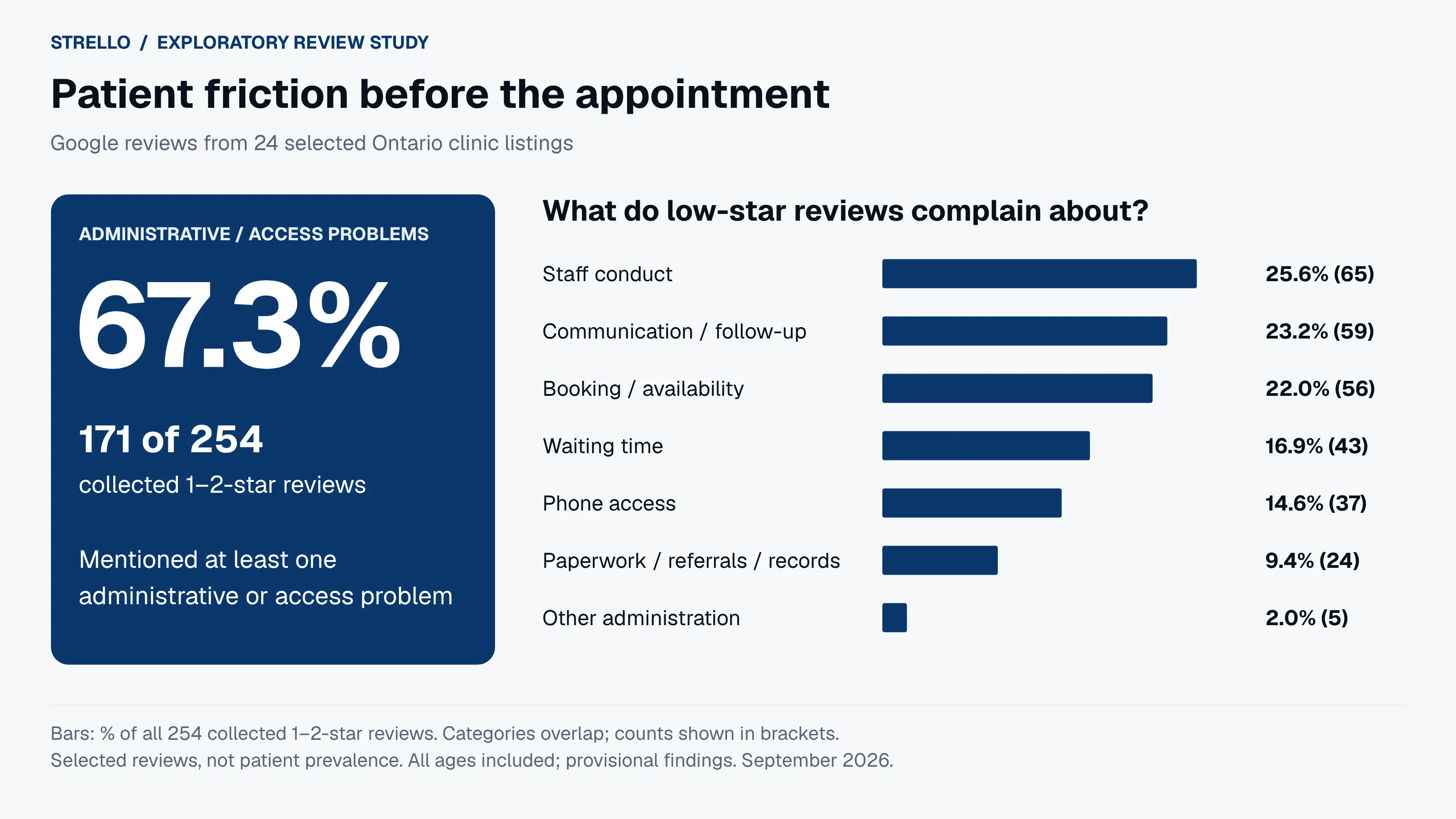
- 67.3% of the collected one- and two-star reviews (171 of 254) mentioned an administrative or access problem.
- 14.8% of the main sample (60 of 406 reviews) described a negative administrative or access experience.
- 7.1% of the main sample (29 of 406 reviews) explicitly praised reception, front-desk or office staff.
We counted access problems such as unanswered calls even when no staff member was named, but counted praise only when it explicitly referred to administrative staff. The negative and positive percentages therefore measure different things.
Where the friction appeared
67.3% mentioned at least one administrative / access problem.
Each bar uses 254 as its denominator. Categories overlap; counts appear in brackets.
Source: Strello exploratory Google-review analysis, September 2026. All available ages included.
Provisional: 37/254 records reconstructed from notes. Findings describe selected reviews, not patients.
The following percentages use all 254 collected one- and two-star reviews as the denominator, including reviews with no identifiable administrative complaint. A review can belong to several categories, so the percentages overlap.
The excerpts are taken from saved review text. We have omitted reviewer and clinic names, retained the original wording, and used only text actually visible in our records. They are illustrative accounts, not independently verified findings about any clinic.
Staff conduct
65 reviews · 25.6% of the low-star sample
Patients described feeling dismissed, spoken to sharply or treated as an inconvenience. Some separated that experience from their opinion of the doctor. Others recognised that the team might be stretched too thin.
“The reception staff come across as rude, dismissive, and completely uninterested in helping patients.”
“If it's that busy, you probably need more staff.”
We do not have the staff member’s account of these exchanges. Workload, backup from colleagues and protection from abuse all matter when asking staff to handle difficult conversations.
Communication and follow-up
59 reviews · 23.2%
Some complaints were about silence. Others were about receiving different instructions from different channels. Both can leave the patient unsure whether to wait, call again or come in.
“I'm always waiting for a call back that never happens.”
“They tell you one thing on the phone and then email you something else.”
Patients need to know when to expect a reply, and staff need to know who is responsible for sending it.
Booking and availability
56 reviews · 22.0%
This category included difficulty obtaining appointments, cancellations and bookings that did not match what patients believed had been agreed.
“I was clearly informed by the front desk that my appointment time was 3:30 PM.”
The reviewer said that, on arrival, they were told the appointment was actually at 1:30 PM. Consistent booking information and confirmations could help prevent this kind of confusion, though they cannot solve a shortage of appointments.
Waiting time
43 reviews · 16.9%
Patients often distinguished between expecting some delay and feeling that their appointment time had no meaning.
Urgent concerns and longer consultations can put a clinic behind schedule. Reception staff need updates from the clinical team so they can explain the delay and give patients a realistic idea of what to expect.
Phone access
37 reviews · 14.6%
These complaints described unanswered calls, repeated attempts and long holds. A patient could value the clinical care and still struggle to reach it.
“I called many times no body answer”
“Clean clinic, and the doctors are nice, but trying to reach them on the phone is exhausting.”
A patient on hold cannot see the queue at the desk. A receptionist helping someone in person cannot answer every call at once.
Other administrative problems
5 reviews · 2.0%
A smaller group described other administrative frustrations, including difficulty resolving payment or refund questions.
We could not verify these disputes. The complaints describe patients struggling to get an explanation or find someone who could resolve the issue.
Patients also notice when the front desk gets it right
In the main sample, 29 reviews explicitly praised reception or office staff. Many reviews said nothing about administration, so this is a count of praise rather than a measure of overall satisfaction.
“Excellent front desk, always answers to our queries.”
“The team at the front desk are also good and polite.”
“Also thank you to the reception staff who are always helpful and friendly.”
Patients appreciated staff who answered their questions and treated them kindly. Staff need enough time to offer that help.
Why we built Strello
Before launching, we interviewed dozens of administrative staff. We wanted to understand which parts of the job they valued and which demands kept pulling them away from patients.
As one of our colleagues put it:
“nobody wakes up in the morning thinking I can't wait to answer 100s of calls”
Welcoming patients, explaining what happens next and helping someone who is confused take time and attention. Depending on their training and role, staff may also room patients or take vitals.
We built Strello to reduce repetitive calls and administrative work, giving clinic teams more time to help patients in person. Patients still need a way to reach a staff member when a request needs judgement or a sensitive conversation.
How we conducted this exploratory study
Setting and selection. We began with 25 proposed clinics in Toronto, Ottawa, Mississauga, Brampton and Hamilton. Twenty-four clinic batches had usable material. Listing identities and changes of ownership were not fully verified. Clinics were selected by convenience, not randomly.
Collection. Google-review material was captured or supplied in September 2026. We aimed for up to 20 newest-order reviews per clinic and a separate, non-overlapping set of up to 10 low-star reviews. Shortfalls were retained.
Denominators. The main sample contains 406 reviews. The low-star analysis contains 254 unique one- and two-star reviews drawn from the main sample and separately collected low-star reviews. Deduplication used available review IDs, reviewer names and matching text.
Coding. A single AI-assisted coding pass classified visible text for administrative/access problems, specific themes, explicit staff references and sentiment. Categories could overlap. Clinical-only complaints, generic dissatisfaction without a specific administrative/access issue, and facility complaints were excluded from the administrative numerator. Star-only and truncated reviews remained in the denominator; no missing text was inferred. Positive front-desk comments were checked separately and could coexist with negative comments.
Interpretation and disclosure. Google reviewers are self-selected. The clinic sample is small and non-random, dates vary, some text is incomplete, and different reviews may describe the same incident. Shared listings may cover more than one service. This was not a representative patient survey or peer-reviewed study, and it had no independent second coder or verification of the events described. Strello conducted the analysis and has a commercial interest in improving clinic administration. The founder interview accounts provide background; they were not pooled with the review data.